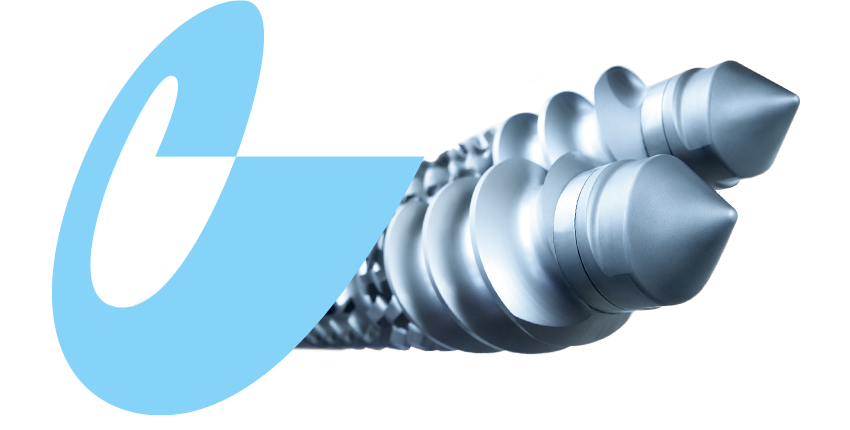
Extruders & Compounding Machines

STS Twin Screw Extruders

Want to find out more about this offering?

Get in touch

STS Compounders Boosting Possibilities in Compounding, Extrusion and Recycling

Over the years, the STS twin screw extruder has established itself on the market as a quality product for a wide range of extrusion and compounding tasks such as engineering plastics, masterbatch, cable masses, recycling of regrind plastics, powder coating, and much more.

The STS twin screw extruder has been developed in Germany, production of the STS is in Nanjing, China, in compliance with CE directives. The result: A high-performance compounding system with low investment costs which ensures a fast return on investment. Each compounding system features smoothly interacting process steps and gentle handling of the product with maximum productivity.

The quality of the end product is always at the center of focus: From feeding, conveying, melting, dispersing, homogenizing, devolatilizing, pressure increase to filtering and pelletizing, Coperion designs every process step to meet the exact requirements of your application. This makes the STS compounding systems the optimal solution for your application.

Adavantages at a glance

↗ High specific torque
↗ Maximum throughput rates
↗ Long service life
↗ Best price-performance ratio
↗ High quality components
↗ Easy installation and operation
↗ European safety standards

Areas of application of the STS compounder

→ Filling and reinforcing of engineering plastics
→ Alloying and filling of polyolefins/TPE
→ Coloring of polyolefins and engineering plastics
→ Production of color masterbatch, flame retardant masterbatch, filler masterbatch and additive masterbatch
→ Recycling of regrind plastics
→ Cable compounds, incl. PVC, HFFR, XLPE
→ Bioplastics
→ Battery materials
→ Other applications

The right STS twin screw extruder for every application


STS Twin Screw Extruders

Coperion Twin Screws

Self Cleaning Screw Profile

The closely intermeshing twin screws eliminate stagnant zones over the whole process section.

Thanks to their tight, self-wiping profile the result is a consistently high degree of process reliability and optimal self-cleaning throughout the process section.

Modular Design

The process section of the STS is designed as a modular system. It consists of several barrels in which the co-rotating screws operate. The advantage of this modular principle is maximum flexibility in compounding and extrusion processes.

Our process engineers configure the barrels and screw elements individually to meet your application’s specific requirements. Different process zones are created as required for conveying, plasticizing, mixing and shearing, homogenizing, devolatilizing and pressure build-up in order to achieve highest product quality and maximum throughput rates. The temperature of every barrel can be controlled individually. Heating is achieved by means of electrical heaters, the cooling is achieved by water. Standard barrels and screw elements are made of nitrided steel. Special high-alloy wear-protected steels are used in the enhanced wear and corrosion protected version.

1/1

Masterbatch Processing

Masterbatch production makes great demands on the compounding process: the pigments and additives must be mixed into the base polymer absolutely homogeneously. STS twin screw extruders are particularly suited to masterbatch production because of their excellent mixing properties and gentle product handling at a very attractive price-performance ratio. The STS achieves best dispersion of pigments at lowest specific energy input.

Different Masterbatch Set-Ups

Coperion: Typical Set-up for the Production of Masterbatch in Premix Process
𝗠𝗮𝘀𝘁𝗲𝗿𝗯𝗮𝘁𝗰𝗵 𝗣𝗿𝗲𝗺𝗶𝘅 𝗣𝗿𝗼𝗰𝗲𝘀𝘀: 1 Polymer pellets I 2 Pellet mill I 3 Wax I 4 Pigments I 5 Polymer powder I 6 Mixer, e.g. hot/cool mixer I 7 Volumetric feeder I 8 Twin screw extruder STS I 9 Vacuum degassing I 10 Strand die head I 11 Water bath I 12 Air knife unit I 13 Pelletizer

Premix process

In the premix process, all components are combined in a mixer and then conveyed via a volumetric feeder into the STS extrusion system.

Recipe ingredents
Base polymers: PE, PP, PS, EVA, PET, PA, PC, SAN, PMMA, ABS, TPE, POM, etc.

Pigments/additives

Organic pigments 20-40%
Inorganic pigments 40-60%
Carbon black 15-40%
TiO₂ 50-70%
Synthetic SiO₂ 10-30%
Natural SiO₂ 30-50%
Low melt substances such as additives
(UV, antifog, antistat, etc.)
10-20%

Advantages at a glance

↗ No loss of product during start-up
↗ Simple operation of all system components
↗ Very good shearing behavior to distribute pigment agglomerates
↗ Quick cleaning when changing colors
↗ Low investment costs

Coperion: Typical Set-up for the Production of Masterbatch in Split Feed Process
𝗠𝗮𝘀𝘁𝗲𝗿𝗯𝗮𝘁𝗰𝗵 𝗦𝗽𝗹𝗶𝘁-𝗙𝗲𝗲𝗱 𝗣𝗿𝗼𝗰𝗲𝘀𝘀: 1 Polymer pellets I 2 Wax I 3 Pigments I 4 Polymer powder (optional) I 5 Mixer I 6 Gravimetric feeder I 7 Twin screw side feeder I 8 Twin screw extruder STS I 9 Atmospheric degassing I 10 Vacuum degassing I 11 Strand die head I 12 Water bath I 13 Air knife unit I 14 Pelletizer

Split-Feed Process

In the split-feed process, the polymer is metered into the upstream portion of the STS twin screw extruder. After it has been melted, the additional pigments or additives are fed via a twin screw side feeder into the extruder. Gravimetric Feeders are generally used in this step.

Recipe ingredents

Base polymers: PE, PP, PS, EVA, PET, PA, PC, SAN, PMMA, ABS, TPE, POM, etc.

Pigments/additives

Organic pigments 40-60%
Inorganic pigments 50-80%
Carbon black 20-50%
TiO₂ 60-80%
Synthetic SiO₂ 20-50%
Natural SiO₂ 40-60%
Low melt substances such as additives
(UV, antifog, antistat, etc.)
30-60%

Advantages at a glance

↗ Good product quality
↗ Low wear
↗ High pigment or additive loading possible
↗ Gentle product handling


Coperion: Typical Set-up for the Production of Masterbatch in Color Matching Process
𝗖𝗼𝗹𝗼𝗿 𝗠𝗮𝘁𝗰𝗵𝗶𝗻𝗴 𝗣𝗿𝗼𝗰𝗲𝘀𝘀: 1 Preload hoppers for masterbatch I 2 Gravimetric feeders I 3 Twin screw extruder STS I 4 Atmospheric degassing I 5 Strand die head I 6 Water bath I 7 Air knife unit I 8 Pelletizer

Color Matching Process

Both the premix and the split-feed process can be used to manufacture masterbatch with a single pigment type. This product is known as a monobatch, SPC or SPD. Within the color-matching process different monobatches are premixed or fed separately into the extruder. The STS extruder plasticizes and mixes them, so that the product obtained is a masterbatch with the desired color. Monobatches based on all common carrier polymers are used for this process.

Highlights of the STS in Masterbatch Processes

Coperion twin screw extruder STS Mc11 swivel arm

STS side feeder: new design with swivel arm

  • Swivel arm allows easy docking and optimal alignment to adjacent barrels
  • Engineered by Coperion Stuttgart, Germany, equipped with European gearbox, final assembly at Coperion Nanjing, China
  • High torque, deep cut screw channels and Do/Di ~ 2 to achieve high throughput rates
  • High pressure built up to 30 bar
  • High-low speed motor or frequency control motor
  • High manufacturing precision, only 2 mm clearance between side feeder screws and twin screws of STS
Coperion twin screw extruder STS Feed Hopper

Feed hopper in quick-change design

The feed hopper is simply clamped to the inlet barrel and can be quickly removed by loosening the bolts. The quick-release insert which protects the barrel wall from contamination can then be changed very easily.

Coperion STS Die Head

Quick cleaning die head

  • Simple, quick opening by loosening a few bolts
  • User-friendly assembly due to pivoting arm
  • Insertion of screens possible by using breaker plates
  • Optimized flow geometry with minimal dead space for safe strand discharge, even with highly filled products
Coperion Feeders

Smart Feeding Solutions

Every processing application has unique requirements, and Coperion provides one of the most extensive selections of feeding equipment available. Its portfolio includes screw feeders, vibratory feeders, bulk solids pumps, weigh belts, liquid feeders, and flow meters. Each product is available in multiple designs and can be integrated in various combinations to deliver the most effective solution for virtually any application.

Find the right feeder

ProRate PLUS Feeders

Discover an affordable feeding solution backed by proven Coperion K-Tron quality. The ProRate PLUS continuous gravimetric single and twin screw feeders, with and without refill solutions, are an economical solution for many secondary plastic applications. Depending on the formulation, ProRate PLUS feeders can be installed as individual units or easily arranged in a group of up to six feeders around a process inlet.

Discover more

Downloads

Subscribe to the Coperion Newsletter